Wednesday, May 19, 2010

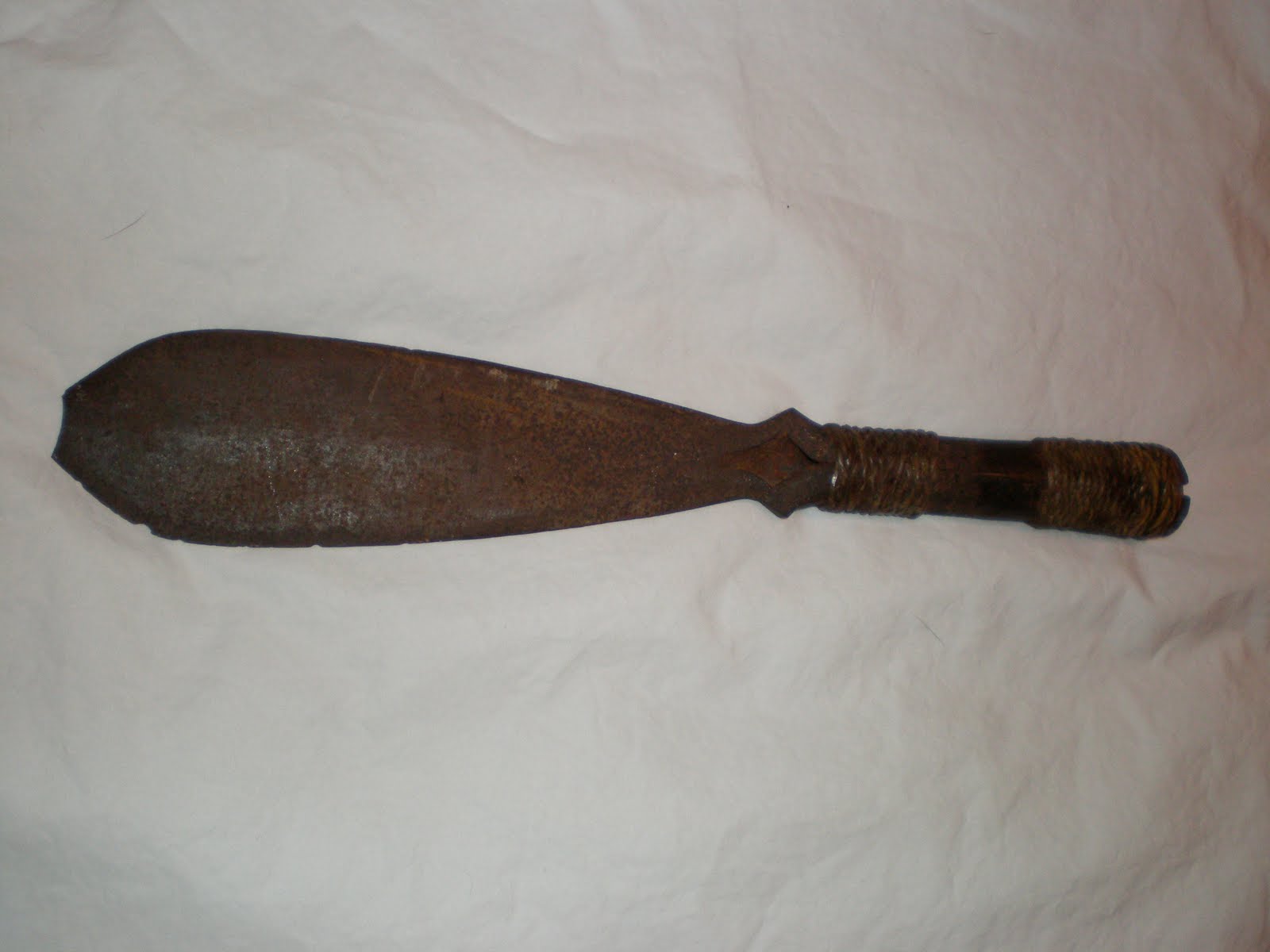
A hinalung knife/spear from the Philippines


I paid very little for this old Northern Filipino ("Igorot") knife/spear blade a few months ago. The item was poorly described and the pictures were terrible, and I was not particularly surprised when I opened the package and discovered a blade in very poor shape. Still, it's an older piece and one made for use, so it was worthwhile. This is an example of a peculiar necktie-shaped spear blade, known as a hinalung, that doubles as a knife. Although any spear blade could conceivably double as a knife, these are designed to serve as both utilitarian knife and hunting weapon.


The hinalung is strongly influenced by the socketed Filipino spears known as budiaks or budjaks. Originally a permanently-mounted spear blade (and originally much slimmer in shape), the hinalung would have been an effective hunting/martial weapon. At some point, possibly during the American occupation during the early 20th century, the Igorots turned the hinalung into a dual use weapon to circumvent weapons laws. (See the essay "Hinalung & Pinahig: Weapon-Tools of the Igorot" on the excellent website Mediaeval Sword Resource Site for more & better information.) The blades were kept in open wood scabbards, similar to those used throughout Indonesia and on into Taiwan. The weapon suffers from the compromises needed to create a dual-use weapon - it's stubby, unwieldy, and not particularly comfortable to hold.

Overall, the point is short and wide (i. e., stubby). The item is forged from one piece of steel, probably recycled from an old automobile leaf spring or similar. The blade is ovoid in cross-section with evidence of repeated sharpening. The socket/handle is bound with several bands of woven rattan, each about 1/3" wide.


The item is in very poor shape. Superficially, the blade appears well-used, with an even dark, dusty patina, light rust, and pitting. At least 1/2" is broken off the tip, and the left-hand edge (when viewed from the side with the seam) is chipped in several places. The rattan rings are grimy from use.


I suspect this is a WWII era piece. I believe most Filipino artifacts date from 3 eras: the Spanish-American War/Philippine Insurrection period (1890-1910 or so, see "Uncle Sam, The Moros, and the Moro Campaigns" for more info), during or shortly after WWII (1940-1950), and the Vietnam era (1965-1975 or so), when GIs were stationed in the Philippines. I doubt this hinalung is particularly old, but it's well made overall and was not made for sale to tourists.

Length (overall): About 11 1/2". Would have been about 12" if complete.
Length (blades/points): About 6" from tip of blade to base of hilt.
Length (other dimensions): Handle/socket is about 5".
Width at widest point (blade/point): About 2" across at the widest point.
Width (other dimensions): Handle/socket is about 1" in diameter.

Materials: Recycled steel.

A nice addition to my small Filipino collection, which also includes several talibong-type knives, a bow, and a few arrows. I also have a contemporary tourist-art Filipino crossbow I am attempting to sell.

Monday, May 17, 2010

Auctions


Here are a few eBay auctions I watched (and unsuccessfully bid on) this weekend. I was outbid on each of them. I did pick up an old, used Papuan cooking utensil made with a coconut shell. I will describe that within the next few weeks.

A Kikuyu spear collected by Quaker missionaries in the 1920s. In perfect condition with a light-colored wood shaft. Sold for about $120.

A massive spear from the Sudan. In very good condition, including brass wire wrap near butt. Shaft is a little warped near butt. Sold for about $150. Shipping would have been prohibitively expensive.

A nice Ngbandi spear from the northern Congo. In excellent condition, with a nice blade and plenty of wire wrapping. I purchased a similar item from the same seller. The one I purchased (and thus, was able to afford) is missing a section of the butt. This complete spear sold for $78, which is not much more than I paid for mine.

A large Zulu assegai or iklwa from South Africa. Point is bound with leather. Appears complete. Sold for $175.

A Yakoma spear from the Congo. An interesting, very light-weight status symbol-type spear. Sold for $121.

A Ngbandi spear head. A strange, thin point with strong barbs; probably part of a status symbol-type spear like #5. It would have made a deadly thrown spear, however. Sold for about $50.

A Somali spear head. Small and light, with a decorative element at base of blade. Similar to the point i described here. Sold for $39.

A spear head from the Congo. Rather crudely made, with a very large barb. A functional hunting weapon. Sold for $40.

An interesting spear head from Uganda. Solidly built and finely made, with two fullers like the Ethiopian points I described here and here. Sold for $40.

A Mossi spear head from Burkina Faso, West Africa. Nicely made for a West African piece, with a long shank and a narrow, willow-leaf shaped blade. Sold for $43.

An arrow point from the Congo. Appears quite old, and is nicely decorated with filed and chiseled elements. 5" overall. Crisp, symmetrical form. Recalls some of the points from the northern Philippines. Has an excellent patina. Sold for a pretty ridiculous $100, at least 2 or 3 times what it's actually worth.

A harpoon point from the Congo. A very graceful, delicate form with very strong barbs. Of a different form than the Congolese harpoon I have in my collection. Retains some of the vegetable fiber cord. Sold for $82.

A very nice Malagasy spear head and butt. Shape of point recalls shape of Sudanese spear (#2). A solid, functional piece with decorative brass inserts.

Kind of a discouraging lot of auctions, but maybe I'll have better luck next time. I would rather be surprised with a good deal on a good piece than have to pay what an item is actually worth (or more than it's worth.)

Sunday, May 16, 2010

An antique spearhead from Java, Indonesia


This is the first of a few Asian spearheads I will be presenting. Acquiring this particular blade was an accomplishment - I paid much less than I feel the point is worth, and certainly much less than the point will be worth in a few years. This is an antique kris-shaped spear point from Java, Indonesia. Said to be from the Pajajaran period (14th-15th centuries), when Java was part of a widespread Hindu radiation originating in India. The blade may be made from meteorite iron, the traditional material for old kris blades.


Overall, the point is long and wide with two waves. The blade is tanged for insertion into a wood shaft. A slight midrib is still present. The surface of the object is very rough, with an eroded appearance. These primitive wootz or Damascus blades are made from several layers of folded iron. The Javanese bring out the pamor or grain patterns in the blade by washing them with acidic solutions including citrus juice. As a result of this process, the older the blade is, the thinner and more eroded-appearing the blade becomes. Thus, this particular point may have been longer and wider in the past. A round decoration, neatly filed into the metal, serves as a hilt.

The blade is mounted in a shira-saya type display shaft and cover, both of modern manufacture. The cover, made from a tropical hardwood (possibly narra wood), is known as a warangka. The short, nicely tapered shaft with a turned finial element, is made from the same hardwood and is known as an ukiran. The tang of the blade fits snugly into the fitting when wrapped with a strip of cloth.


This is a functional and solidly-built weapon. Even if it is not as old as advertised, it is made from fine watered steel in the traditional fashion. Kris-type blades and spears have immense symbolic value for Indonesians. Unfortunately I don't have enough experience with or knowledge of Indonesian blades to go into much detail here.

Length (overall): About 24 1/2".
Length (blades/points): About 11 1/2" from tip of blade to base of hilt. Tang is about 5".
Length (other dimensions): Shaft is 13". Scabbard is about 12".
Width at widest point (blade/point): About 2 1/2" across the prongs at the widest point.
Width (other dimensions): Scabbard is about 4" across at widest point.

Materials: Watered steel. Shaft and scabbard are made from tropical hardwood (possibly narra wood).

This is a great old antique item. I hope to display it on a bookcase at some point. I have a recently-made decorative spear from the same region with a more kris knife-type blade and a complete shaft.

Saturday, May 15, 2010

Previews...

I just received a nearly-complete Ngbandi stabbing lance from the Central African Republic. I will get to that next week. I also have a workshop-made medieval-type crossbow in the mail (but that will probably have to wait until I get to my other crossbows). I will describe a few Asian spears shortly, and review "Material Culture of the Formosan Aborigines" by Chen Chi-Lu when it shows up in my mailbox. Particularly interested (of course) in Formosan crossbows, arrows, etc. Should be some nice pictures of the Formosan knives with integral handles, like the Northern Philippines hinalung and pinahig knife/spears.

A bident spearhead from Ethiopia, Africa


Here is another spearhead from Ethiopia. This piece has an unusual bident configuration, with paired willow-leaf shaped points diverging from a shared base. Otherwise, it shares many characteristics with the more conventional spear I described in my last post. Both spears are decorated with a checkerboard design of alternating sections of bare metal and oxide. The top and bottom of the socket is decorated with a band of bare metal, as is what I guess would be the ricasso? This point has the same long socket and willow-leaf shaped blade (blades, in this case). The twin blades have strong midribs with concave areas left coated with dark-colored oxide.

This spear has no functional value (I'm sure you could find a utilitarian use for a forked spear, but this particular piece is too light and not well-designed for hunting or martial use.) This spear, too, may be more of a cultural item. There's always a temptation to label an unusual item a "ceremonial" piece (read: "I don't know what this is"). This one might actually have some symbolic value: I doubt I still have the PDF, but I once read a paper by a Swedish author describing various bident spears from Africa, all of which had symbolic value.

Like the other Ethiopian point, this is not particularly well-made, but appears to be at first glance. Overall, the shape is trim and elegant. Although the points are needle-sharp, the edges are blunted, which generally indicates a tourist-art origin. A small bit of sprue is left in the area between the prongs. Would have been used with a6-7' hardwood or possibly bamboo shaft. I hope to pair this with a cane shaft in the near future. There's a small, 1/8" hole (neatly drilled) near the base of the ferrule for a pin. Another interesting feature shared by both spears is a neat "hem" of sorts at the base of the ferrule. Instead of ending in a ragged or chisel-cut edge, the material is turned on itself for about 1/4". Makes for a neat, tidy appearance.

Length (overall): About 15".
Length (blades/points): About 7 1/4".
Length (other dimensions): Socket is about 5 1/4".
Width at widest point (blade/point): About 2" across the prongs at the widest point.
Width (other dimensions): Base of points (ricasso?) about 1".

Materials: A lightweight piece of steel. Object has a dirty, dusty appearance (would benefit from a light cleaning). The steel is not high-quality and was probably recycled from scrap materials. The ferrule or socket is long, with an opening slightly less than 1".

I remember seeing a similar spear on display at the Houston Museum of Natural History's Lucy exhibit several years ago. A conventional and bident spear were on display, which leads me to believe they were acquired together. The patchwork design seems diagnostic for Ethiopian spearheads, although it's probably found on Somali points as well. I've passed up opportunities to obtain Ethiopian arrows, quivers, etc (were not particularly high quality). This is the last of the Ethiopian items I'll be describing.

Thursday, May 13, 2010

A spearhead from Ethiopia, Africa


Up next is a nice, slim spearhead from Ethiopia. It has a narrow, willow-leaf shape and a long socket or ferrule decorated with a patchwork design. The blade has a strong midrib, with concave areas left coated with dark-colored oxide. I don't think it's necessarily a utilitarian item - it is thin and light and would not stand up to much serious use. It may be more of a cultural item, from an area where men habitually carry spears yet rarely use them.

Although the piece is not necessarily well-made, it certainly looks like it was. Overall, the shape is trim and elegant. The strong midrib and bare metal/oxide decoration make for a dramatic appearance (much like the Tutsi spearhead I described last weekend). Another interesting decorative feature is the patchwork or checkerboard design of oxide and metal created by removing areas of oxide. The nice, long ferrule is a strong, functional element. The edges are blunted, which generally indicates a tourist-art origin. Would have been used with a 6-7' hardwood or possibly bamboo shaft. I hope to pair this with a cane shaft in the near future. There's a small hole near the base of the ferrule for a pin.


Length (overall): About 17".
Length (blade/point): About 10 1/4".
Length (other dimensions): Socket is a little over 6".
Width at widest point (blade/point): About 1 1/4".
Width (other dimensions):

Materials: A lightweight piece of steel. Object has a dirty, dusty appearance (would benefit from a light cleaning). A forging flaw is evident on one of the blade's faces. The steel is not high-quality and was probably recycled from scrap materials. The ferrule or socket is long, with an opening slightly less than 1".

I remember seeing a similar spear on display at the Houston Museum of Natural History's Lucy exhibit several years ago. A bident spear was also displayed (I have one I'll be describing shortly). The patchwork design seems diagnostic for Ethiopian spearheads, although it's probably found on Somali points as well.

Wednesday, May 12, 2010

Previews...

Here's the plan for the immediate future: Describe entire collection, then describe new acquisitions, review books and websites, and philosophize about material culture in general.

Describing my entire collection will take a least a couple of months. I will continue with spears, fish spears, and harpoons, then move on to knives, axes and swords. This summer I will tackle bows, crossbows, arrows, and loose points. At some point I hope to relate my efforts to make replica shafts for a handful of smaller spear points and my experiences at local flea markets and antique shops.