Showing posts with label Asia. Show all posts

Monday, May 24, 2010

eBay updates

Didn't do as well as I'd hoped to...

I ended up winning three knives: A WWI era Gurkha kukri knife from Nepal, a contemporary Tuareg dagger, and an interesting handmade WWII theater knife. Prices ended up being on the lower side, which is a good thing. I may end up selling the WWII knife and possibly the kukri - I'll have to see how it compares to my other kukri.

I was outbid on these items (I am proving a link to the completed auctions; I'm not sure how long they will be available):

  1. A unique spearhead from Tanzania with an interesting socket (appears to be made from a coil of steel). Sold for $34. I lowered my bid to $25 because I wasn't terribly impressed with it.
  2. Another Central African harpoon, with a more elongated shape. Work was a little rough. Sold for $47. I was the second highest bidder on this one.
  3. A sturdy Ethiopian spear head from the Danakil Depression. Similar to this one, but more robust and less ornate. Sold for about $150, which I imagine is probably about what it's worth.
  4. A Central African Tetela spear blade. An old, used piece, but still very nice and with a striking configuration. Sold for $55.
  5. Another Yakoma spear from Central Africa. Sold for about $200.
  6. Another Mossi spear from Burkina Faso. Blade's been bent and repaired. Sold for a very high $80.
  7. A Filipino dagger from the early 20th century. Nice configuration, with a restored pommel. Sold for a reasonable $45.
  8. A Finnish puukko knife with a damaged sheath. Knife itself is in great shape. Sold for $40.
  9. A Gurkha kukri knife similar to the one I purchased. Sold for $55.
  10. Another kukri, plainer but better constructed than the first. Sold for $65.
  11. A third kukri, a British Mark 1 used in WWI. Sold for a very high $330. One of the most collectible kukris.
  12. Lastly, someone beat me to this Central African (Mongo?) arrow.

Sunday, May 23, 2010

A delicate fish spear from Thailand


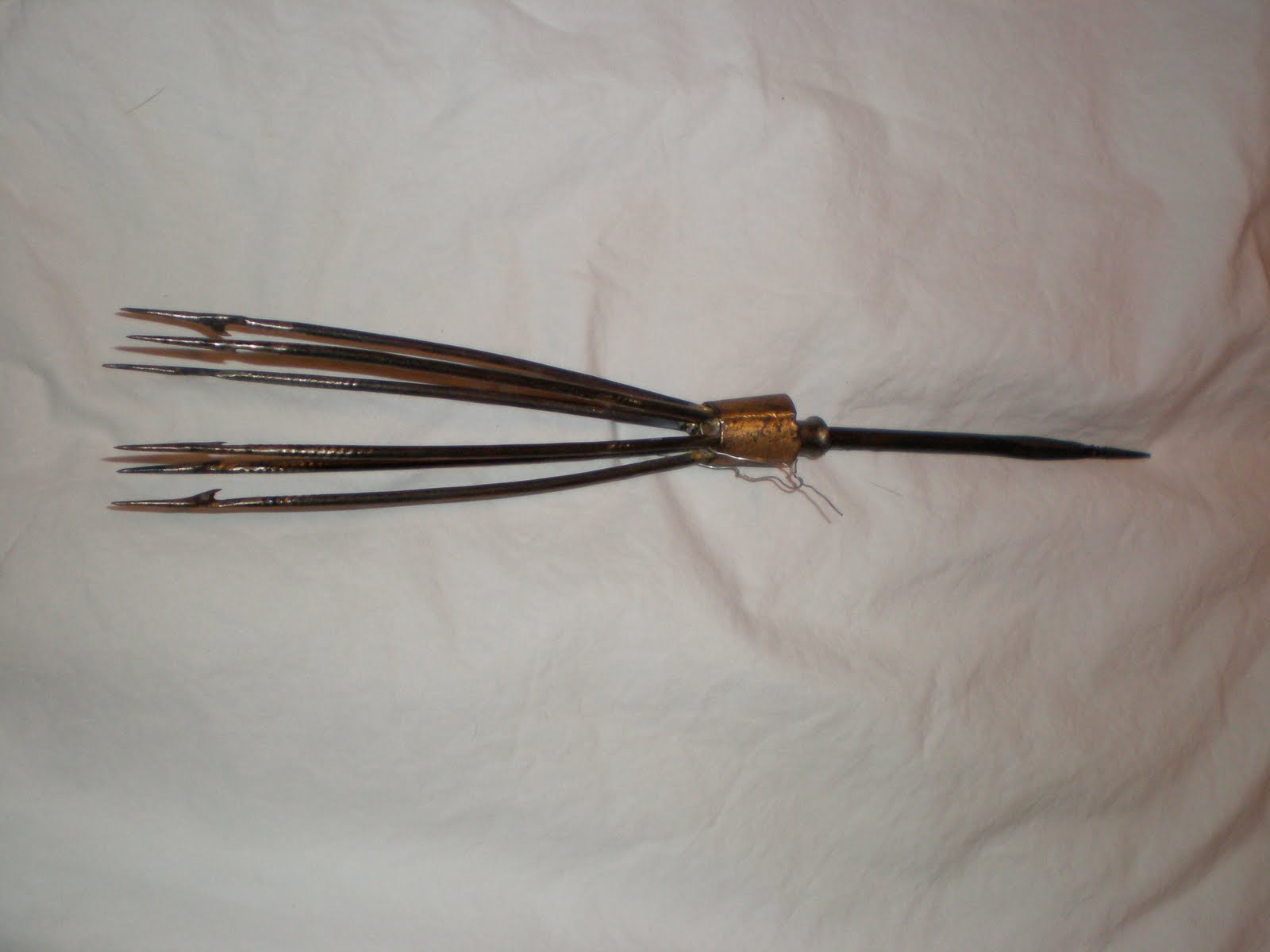
Here's a description of the first of my spearheads designed explicitly for fishing. I bought it from an eBay seller who indicated it was from Vietnam. I assumed this was the case for years, but while rummaging through my collection recently I took a closer look at the object. There's definitely a couple of characters in Thai script on the upper part of the tang (may be visible in the photo below).

These spears with numerous barbed tines arranged radially appear to be widespread across Southeast Asia and Oceania. Many (but not all) tribal fish spears have tines arranged in a circle around a central point, much like modern paralyzer points for underwater spearfishing. They work quite well, and are possibly easier to manufacture than some of the conventionally trident-type fishing spears from Europe and the western hemisphere. At their most rudimentary, such spears consist of a handful of stiff wires shoved into the reinforced end of a bamboo shaft (as in the omnipresent fish spears from Australia and the Pacific).

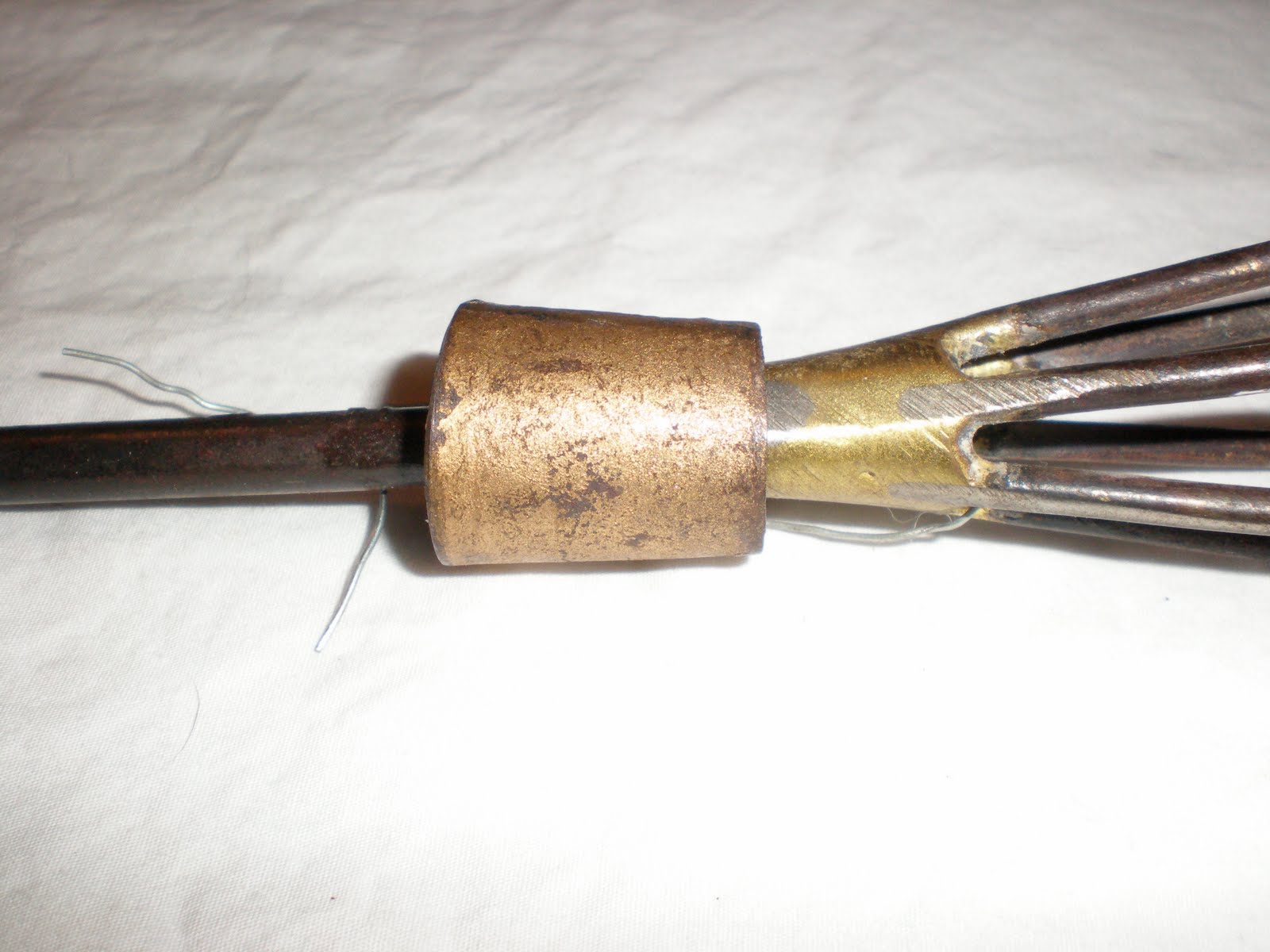
The item is very solidly constructed and vibrates like a tuning fork when struck. The spearhead is made from quality steel tines brazed (I assume it's brazed - the welding material is copper colored) to a square-sectioned steel tang. The barbs are crisp and neatly filed into the wires. The barbs aren't simply struck into the material with a chisel, as you see on contemporary pronged fish spears - they're expertly filed into the slightly flattened ends of the prongs. As you can see from the pictures, the prongs angle out from the base for about half their length, then end up roughly parallel to each other. The base is filed into a sleek, graceful shape and finished with a rounded shoulder.

The tang is long, with a mostly round cross-section. At the base, the tang tapers to a sharp, 4 sided point. The material is twisted 2 times, perhaps to aid screwing the tang into a bamboo shaft. The point includes a small, conical bronze-colored ferrule to slip over the end of the shaft to prevent splitting. This seems to be a common feature in Asian spears: Rather than reinforcing the shaft's socket with leather or wirework, many Asian spears (including southern Filipino budiaks and northern Filipino falfeg-type spears [and presumably continental Southeast Asian spears, but I'm not too familiar with them] incorporate metallic caps or ferrules to reinforce the shaft).

Overall, the point delicate and surprisingly graceful. The tines are made from very springy, resilient steel. I occasionally fish with hand-thrown spears, and bent tines are a constant issue - the tines on this spear are probably more likely to break than bend (which is not necessarily a positive quality), but if so, rarely. The item is not used and plenty of filework is still evident.


The item is in very good shape. Superficially, the object appears unused, with minimal patina from handling and loads of bare metal from manufacture. I suspect this was produced within the past 10-15 years by a fairly large-scale artisinal blacksmith for local use. I imagine these points are in demand by farmers seeking to add protein to their starch-heavy diet. Rice paddies are full of shrimps, small fishes and eels, and amphibians (all ideal quarry for such a light fish spear). These points would be ideal for opportunistic non-commercial spearfishing.

Length (overall): About 11 1/2" overall.
Length (blades/points): About 5 3/4" from tip of points to base.
Length (other dimensions): Tang is about 4 1/2".
Width at widest point (blade/point): Tines are about 2" across at the widest point.
Width (other dimensions): Base (section between base of points and beginning of tang) is about 1 1/4"

Materials: Spring steel (maybe heavy piano wire?).

My Thai collection is pretty limited (exactly one other item, a Vietnam-era daab sword). More on that later...

Wednesday, May 19, 2010

A hinalung knife/spear from the Philippines


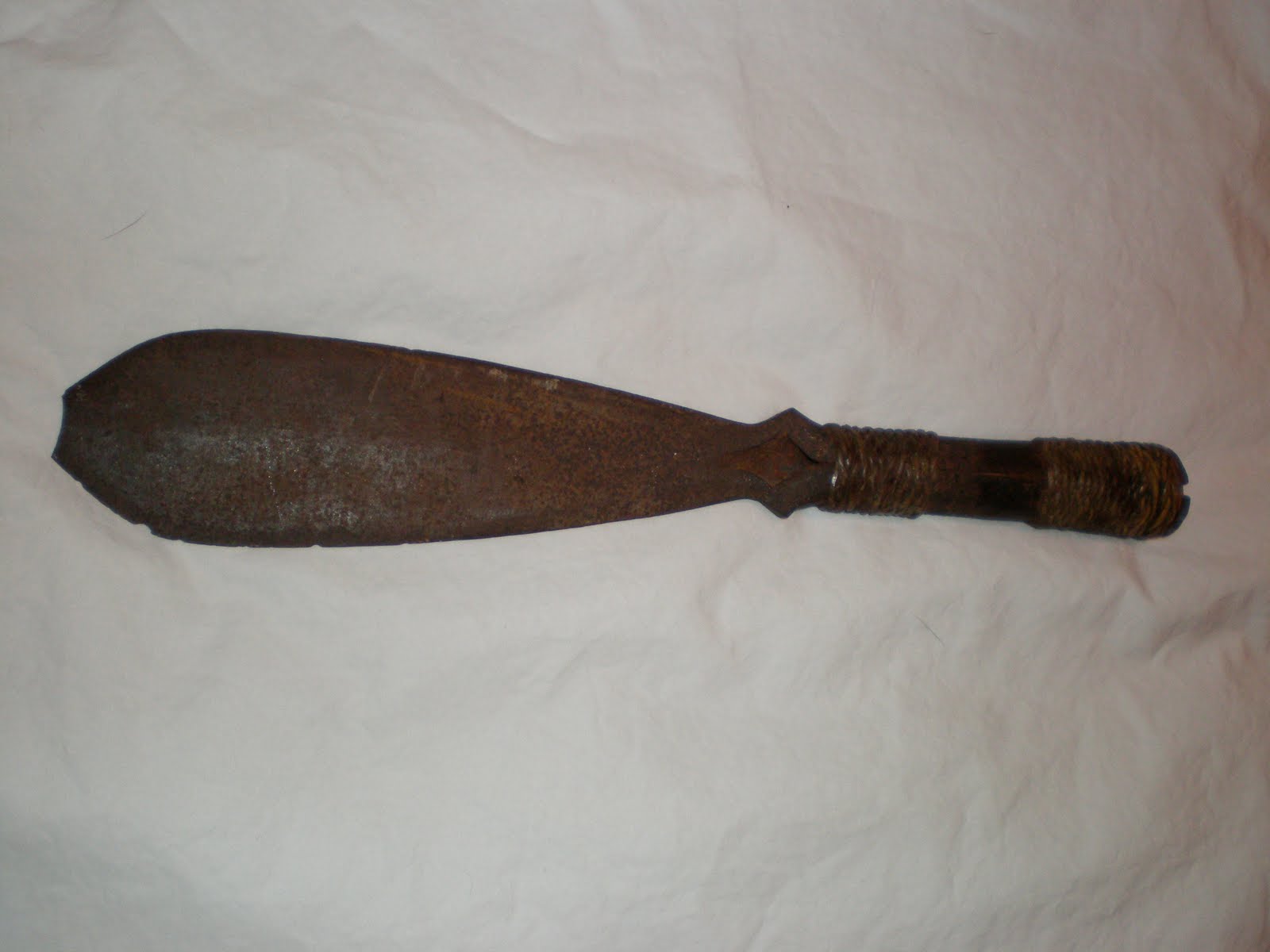
I paid very little for this old Northern Filipino ("Igorot") knife/spear blade a few months ago. The item was poorly described and the pictures were terrible, and I was not particularly surprised when I opened the package and discovered a blade in very poor shape. Still, it's an older piece and one made for use, so it was worthwhile. This is an example of a peculiar necktie-shaped spear blade, known as a hinalung, that doubles as a knife. Although any spear blade could conceivably double as a knife, these are designed to serve as both utilitarian knife and hunting weapon.


The hinalung is strongly influenced by the socketed Filipino spears known as budiaks or budjaks. Originally a permanently-mounted spear blade (and originally much slimmer in shape), the hinalung would have been an effective hunting/martial weapon. At some point, possibly during the American occupation during the early 20th century, the Igorots turned the hinalung into a dual use weapon to circumvent weapons laws. (See the essay "Hinalung & Pinahig: Weapon-Tools of the Igorot" on the excellent website Mediaeval Sword Resource Site for more & better information.) The blades were kept in open wood scabbards, similar to those used throughout Indonesia and on into Taiwan. The weapon suffers from the compromises needed to create a dual-use weapon - it's stubby, unwieldy, and not particularly comfortable to hold.

Overall, the point is short and wide (i. e., stubby). The item is forged from one piece of steel, probably recycled from an old automobile leaf spring or similar. The blade is ovoid in cross-section with evidence of repeated sharpening. The socket/handle is bound with several bands of woven rattan, each about 1/3" wide.


The item is in very poor shape. Superficially, the blade appears well-used, with an even dark, dusty patina, light rust, and pitting. At least 1/2" is broken off the tip, and the left-hand edge (when viewed from the side with the seam) is chipped in several places. The rattan rings are grimy from use.


I suspect this is a WWII era piece. I believe most Filipino artifacts date from 3 eras: the Spanish-American War/Philippine Insurrection period (1890-1910 or so, see "Uncle Sam, The Moros, and the Moro Campaigns" for more info), during or shortly after WWII (1940-1950), and the Vietnam era (1965-1975 or so), when GIs were stationed in the Philippines. I doubt this hinalung is particularly old, but it's well made overall and was not made for sale to tourists.

Length (overall): About 11 1/2". Would have been about 12" if complete.
Length (blades/points): About 6" from tip of blade to base of hilt.
Length (other dimensions): Handle/socket is about 5".
Width at widest point (blade/point): About 2" across at the widest point.
Width (other dimensions): Handle/socket is about 1" in diameter.

Materials: Recycled steel.

A nice addition to my small Filipino collection, which also includes several talibong-type knives, a bow, and a few arrows. I also have a contemporary tourist-art Filipino crossbow I am attempting to sell.

Sunday, May 16, 2010

An antique spearhead from Java, Indonesia


This is the first of a few Asian spearheads I will be presenting. Acquiring this particular blade was an accomplishment - I paid much less than I feel the point is worth, and certainly much less than the point will be worth in a few years. This is an antique kris-shaped spear point from Java, Indonesia. Said to be from the Pajajaran period (14th-15th centuries), when Java was part of a widespread Hindu radiation originating in India. The blade may be made from meteorite iron, the traditional material for old kris blades.


Overall, the point is long and wide with two waves. The blade is tanged for insertion into a wood shaft. A slight midrib is still present. The surface of the object is very rough, with an eroded appearance. These primitive wootz or Damascus blades are made from several layers of folded iron. The Javanese bring out the pamor or grain patterns in the blade by washing them with acidic solutions including citrus juice. As a result of this process, the older the blade is, the thinner and more eroded-appearing the blade becomes. Thus, this particular point may have been longer and wider in the past. A round decoration, neatly filed into the metal, serves as a hilt.

The blade is mounted in a shira-saya type display shaft and cover, both of modern manufacture. The cover, made from a tropical hardwood (possibly narra wood), is known as a warangka. The short, nicely tapered shaft with a turned finial element, is made from the same hardwood and is known as an ukiran. The tang of the blade fits snugly into the fitting when wrapped with a strip of cloth.


This is a functional and solidly-built weapon. Even if it is not as old as advertised, it is made from fine watered steel in the traditional fashion. Kris-type blades and spears have immense symbolic value for Indonesians. Unfortunately I don't have enough experience with or knowledge of Indonesian blades to go into much detail here.

Length (overall): About 24 1/2".
Length (blades/points): About 11 1/2" from tip of blade to base of hilt. Tang is about 5".
Length (other dimensions): Shaft is 13". Scabbard is about 12".
Width at widest point (blade/point): About 2 1/2" across the prongs at the widest point.
Width (other dimensions): Scabbard is about 4" across at widest point.

Materials: Watered steel. Shaft and scabbard are made from tropical hardwood (possibly narra wood).

This is a great old antique item. I hope to display it on a bookcase at some point. I have a recently-made decorative spear from the same region with a more kris knife-type blade and a complete shaft.