Showing posts with label Bamboo. Show all posts

Sunday, May 23, 2010

A delicate fish spear from Thailand


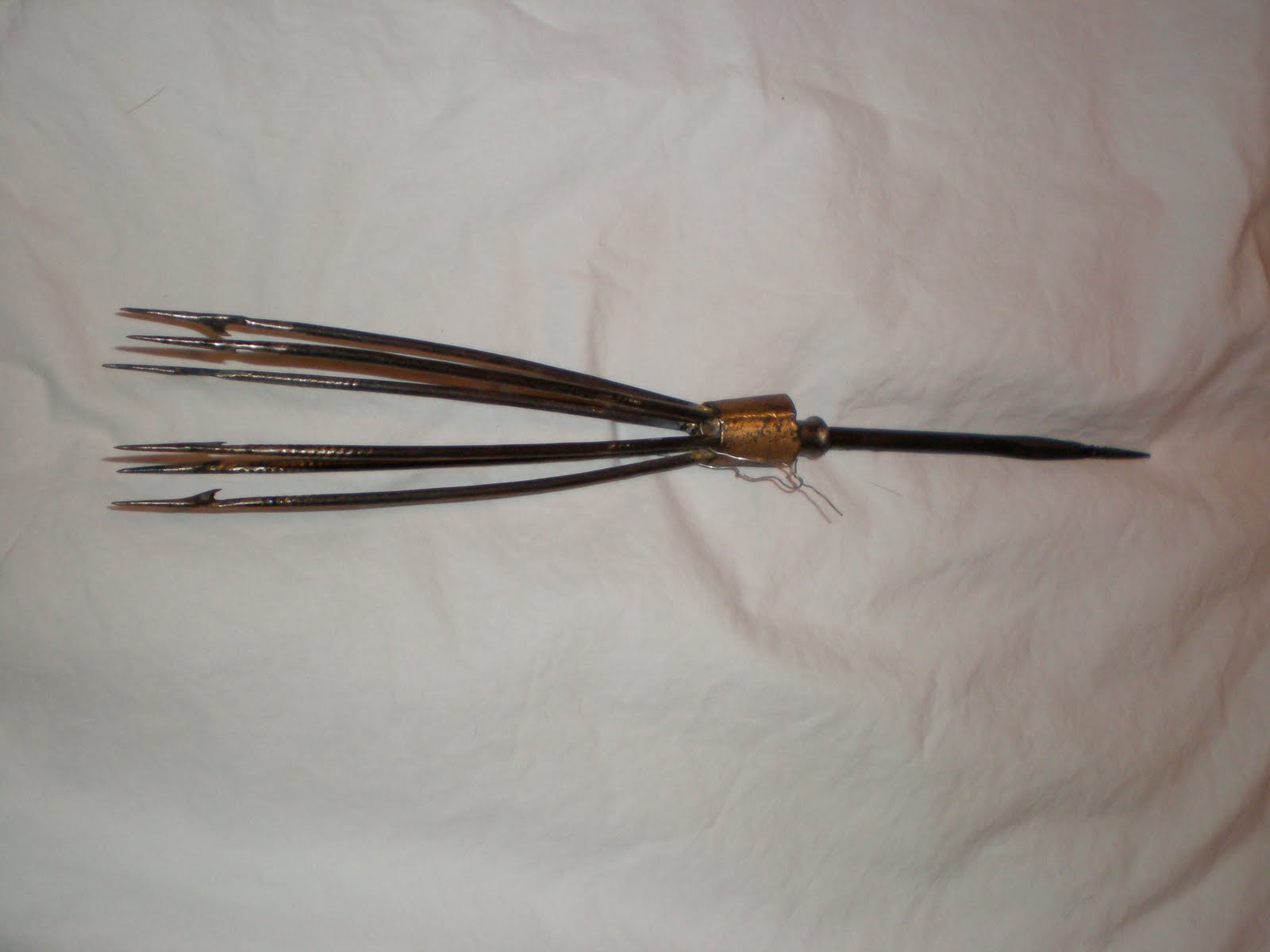
Here's a description of the first of my spearheads designed explicitly for fishing. I bought it from an eBay seller who indicated it was from Vietnam. I assumed this was the case for years, but while rummaging through my collection recently I took a closer look at the object. There's definitely a couple of characters in Thai script on the upper part of the tang (may be visible in the photo below).

These spears with numerous barbed tines arranged radially appear to be widespread across Southeast Asia and Oceania. Many (but not all) tribal fish spears have tines arranged in a circle around a central point, much like modern paralyzer points for underwater spearfishing. They work quite well, and are possibly easier to manufacture than some of the conventionally trident-type fishing spears from Europe and the western hemisphere. At their most rudimentary, such spears consist of a handful of stiff wires shoved into the reinforced end of a bamboo shaft (as in the omnipresent fish spears from Australia and the Pacific).

The item is very solidly constructed and vibrates like a tuning fork when struck. The spearhead is made from quality steel tines brazed (I assume it's brazed - the welding material is copper colored) to a square-sectioned steel tang. The barbs are crisp and neatly filed into the wires. The barbs aren't simply struck into the material with a chisel, as you see on contemporary pronged fish spears - they're expertly filed into the slightly flattened ends of the prongs. As you can see from the pictures, the prongs angle out from the base for about half their length, then end up roughly parallel to each other. The base is filed into a sleek, graceful shape and finished with a rounded shoulder.
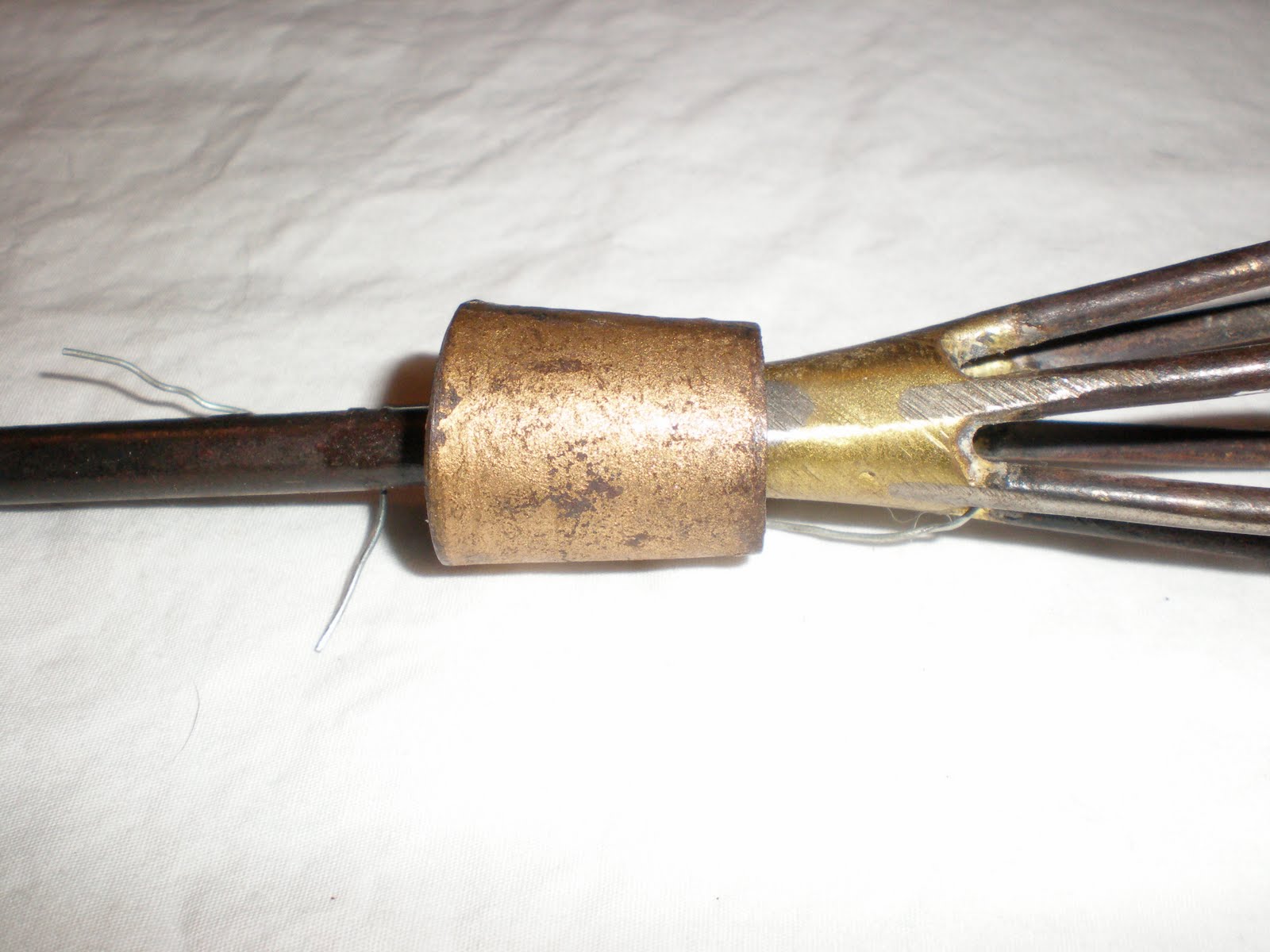
The tang is long, with a mostly round cross-section. At the base, the tang tapers to a sharp, 4 sided point. The material is twisted 2 times, perhaps to aid screwing the tang into a bamboo shaft. The point includes a small, conical bronze-colored ferrule to slip over the end of the shaft to prevent splitting. This seems to be a common feature in Asian spears: Rather than reinforcing the shaft's socket with leather or wirework, many Asian spears (including southern Filipino budiaks and northern Filipino falfeg-type spears [and presumably continental Southeast Asian spears, but I'm not too familiar with them] incorporate metallic caps or ferrules to reinforce the shaft).

Overall, the point delicate and surprisingly graceful. The tines are made from very springy, resilient steel. I occasionally fish with hand-thrown spears, and bent tines are a constant issue - the tines on this spear are probably more likely to break than bend (which is not necessarily a positive quality), but if so, rarely. The item is not used and plenty of filework is still evident.


The item is in very good shape. Superficially, the object appears unused, with minimal patina from handling and loads of bare metal from manufacture. I suspect this was produced within the past 10-15 years by a fairly large-scale artisinal blacksmith for local use. I imagine these points are in demand by farmers seeking to add protein to their starch-heavy diet. Rice paddies are full of shrimps, small fishes and eels, and amphibians (all ideal quarry for such a light fish spear). These points would be ideal for opportunistic non-commercial spearfishing.

Length (overall): About 11 1/2" overall.
Length (blades/points): About 5 3/4" from tip of points to base.
Length (other dimensions): Tang is about 4 1/2".
Width at widest point (blade/point): Tines are about 2" across at the widest point.
Width (other dimensions): Base (section between base of points and beginning of tang) is about 1 1/4"

Materials: Spring steel (maybe heavy piano wire?).

My Thai collection is pretty limited (exactly one other item, a Vietnam-era daab sword). More on that later...

Monday, May 17, 2010

Auctions


Here are a few eBay auctions I watched (and unsuccessfully bid on) this weekend. I was outbid on each of them. I did pick up an old, used Papuan cooking utensil made with a coconut shell. I will describe that within the next few weeks.

A Kikuyu spear collected by Quaker missionaries in the 1920s. In perfect condition with a light-colored wood shaft. Sold for about $120.

A massive spear from the Sudan. In very good condition, including brass wire wrap near butt. Shaft is a little warped near butt. Sold for about $150. Shipping would have been prohibitively expensive.

A nice Ngbandi spear from the northern Congo. In excellent condition, with a nice blade and plenty of wire wrapping. I purchased a similar item from the same seller. The one I purchased (and thus, was able to afford) is missing a section of the butt. This complete spear sold for $78, which is not much more than I paid for mine.

A large Zulu assegai or iklwa from South Africa. Point is bound with leather. Appears complete. Sold for $175.

A Yakoma spear from the Congo. An interesting, very light-weight status symbol-type spear. Sold for $121.

A Ngbandi spear head. A strange, thin point with strong barbs; probably part of a status symbol-type spear like #5. It would have made a deadly thrown spear, however. Sold for about $50.

A Somali spear head. Small and light, with a decorative element at base of blade. Similar to the point i described here. Sold for $39.

A spear head from the Congo. Rather crudely made, with a very large barb. A functional hunting weapon. Sold for $40.

An interesting spear head from Uganda. Solidly built and finely made, with two fullers like the Ethiopian points I described here and here. Sold for $40.

A Mossi spear head from Burkina Faso, West Africa. Nicely made for a West African piece, with a long shank and a narrow, willow-leaf shaped blade. Sold for $43.

An arrow point from the Congo. Appears quite old, and is nicely decorated with filed and chiseled elements. 5" overall. Crisp, symmetrical form. Recalls some of the points from the northern Philippines. Has an excellent patina. Sold for a pretty ridiculous $100, at least 2 or 3 times what it's actually worth.

A harpoon point from the Congo. A very graceful, delicate form with very strong barbs. Of a different form than the Congolese harpoon I have in my collection. Retains some of the vegetable fiber cord. Sold for $82.

A very nice Malagasy spear head and butt. Shape of point recalls shape of Sudanese spear (#2). A solid, functional piece with decorative brass inserts.

Kind of a discouraging lot of auctions, but maybe I'll have better luck next time. I would rather be surprised with a good deal on a good piece than have to pay what an item is actually worth (or more than it's worth.)

Saturday, May 15, 2010

A bident spearhead from Ethiopia, Africa


Here is another spearhead from Ethiopia. This piece has an unusual bident configuration, with paired willow-leaf shaped points diverging from a shared base. Otherwise, it shares many characteristics with the more conventional spear I described in my last post. Both spears are decorated with a checkerboard design of alternating sections of bare metal and oxide. The top and bottom of the socket is decorated with a band of bare metal, as is what I guess would be the ricasso? This point has the same long socket and willow-leaf shaped blade (blades, in this case). The twin blades have strong midribs with concave areas left coated with dark-colored oxide.

This spear has no functional value (I'm sure you could find a utilitarian use for a forked spear, but this particular piece is too light and not well-designed for hunting or martial use.) This spear, too, may be more of a cultural item. There's always a temptation to label an unusual item a "ceremonial" piece (read: "I don't know what this is"). This one might actually have some symbolic value: I doubt I still have the PDF, but I once read a paper by a Swedish author describing various bident spears from Africa, all of which had symbolic value.

Like the other Ethiopian point, this is not particularly well-made, but appears to be at first glance. Overall, the shape is trim and elegant. Although the points are needle-sharp, the edges are blunted, which generally indicates a tourist-art origin. A small bit of sprue is left in the area between the prongs. Would have been used with a6-7' hardwood or possibly bamboo shaft. I hope to pair this with a cane shaft in the near future. There's a small, 1/8" hole (neatly drilled) near the base of the ferrule for a pin. Another interesting feature shared by both spears is a neat "hem" of sorts at the base of the ferrule. Instead of ending in a ragged or chisel-cut edge, the material is turned on itself for about 1/4". Makes for a neat, tidy appearance.

Length (overall): About 15".
Length (blades/points): About 7 1/4".
Length (other dimensions): Socket is about 5 1/4".
Width at widest point (blade/point): About 2" across the prongs at the widest point.
Width (other dimensions): Base of points (ricasso?) about 1".

Materials: A lightweight piece of steel. Object has a dirty, dusty appearance (would benefit from a light cleaning). The steel is not high-quality and was probably recycled from scrap materials. The ferrule or socket is long, with an opening slightly less than 1".

I remember seeing a similar spear on display at the Houston Museum of Natural History's Lucy exhibit several years ago. A conventional and bident spear were on display, which leads me to believe they were acquired together. The patchwork design seems diagnostic for Ethiopian spearheads, although it's probably found on Somali points as well. I've passed up opportunities to obtain Ethiopian arrows, quivers, etc (were not particularly high quality). This is the last of the Ethiopian items I'll be describing.

Wednesday, May 12, 2010

A javelin or spear point from Sudan, Africa


This is an interesting item. Not sure how to classify it - it's midway between a spear and javelin point. I know it doesn't really matter how an object is classified - ultimately, they're all projectile points. It would be at the heavy end of the spectrum for a thrown spear. At the same time, the numerous barbs would render the point pretty useless for hand to hand combat. The rows of barbs might suggest use as a fish spear, but the wide cutting blade is unnecessary for that purpose.

This is not a well-made piece. The socket is rough. The blade is simply flattened out and formed into a lanceolate shape with no indication of a midrib or lens-shaped cross-section. Although long, the barbs are pretty ragged and more excess material could have been removed. Still, I am reluctant to conclude that this is a tourist piece. There's a uniform coating of rust (which could have been artificially added, of course). Combined with a balanced bamboo shaft, this would have been an effective weapon against opponents or for medium-sized game. Decoration consists of a series of chiseled crosshatching and rudimentary reverse barbs at the base of the shank.

Length (overall): About 13 3/4".
Length (blade/point): A bit over 3".
Length (other dimensions): Socket is 3". Shank is about 7". Barbs are about 1/2".
Width at widest point (blade/point): About 1 1/4".
Width (other dimensions): Shank is about 1/2" by 1/2".

Materials: A solid piece of steel. Entire object is covered with a uniform coating of discoloration (not necessarily rust, but a dark, powdery brown patina). Appears to have been made from a narrow bar of iron, hammered flat at one end for a socket and flattened at the other for a blade. Barbs were lifted from the stock with a chisel. Shaft was probably pretty utilitarian. The ferrule or socket is on the small end with a 3/4" opening.

The strongly-barbed point resembles the fish spears widespread throughout the Sudan area, but especially associated with the Dinka. Many were brought back from the Madhist campaigns, but i suspect this one is later. Hope to put it on a cane shaft before too long.

Monday, May 10, 2010

A javelin point from Somalia, Africa


I purchased this small javelin point via eBay last month. I paid about what I imagine it's worth. Somali pieces seem to be pretty desirable, based on other auctions i've watched. This little point definitely passes the made-for-use test. Overall, it's solidly made from thick steel, and is quite sharp. I've noticed that northeast African points tend to be simple in comparison to the more baroque designs of central Africa and the Sahel. The reverse barbing is a dramatic feature, even if it impedes functioning of the main barbs. I imagine these light javelins were carried by mounted warriors in sets of three or more. I suspect they were carried for status/cultural reasons, but they would make effective hunting or military weapons.


Length (overall): About 8 1/2".
Length (blade/point): A bit over 6".
Length (other dimensions): Socket is 2". Both sets of barbs are about 1".
Width at widest point (blade/point): A hair over 1".
Width (other dimensions):


Materials: A solid piece of steel. No forging flaws evident. Some bits of steel remain at the base of the barbs. Slight discoloration, but no pitting or extensive rust. Judging from pictures and other examples on eBay, shaft was a light-colored hardwood, probably glued in place with gum?Shaft was probably on the shorter side, maybe 5'. The butt of the spear would have had a simple coil of brass wire or a strip of iron cut from a sheet.


The ferrule or socket is tiny with a very narrow opening (1/2"). The shaft would have to have been tapered a great deal, and then glued in place. The point is decorated with brass or copper wire, now tarnished. There are two separate bands of intricate woven wirework.


The blade is slightly lens-shaped in cross-section without a median ridge. The point appears to have been sharpened a little, but not a great deal. The point and edges are quite sharp. File marks present. I like these small, ornate javelin points from central and eastern Africa - I have one other old Central African javelin point I hope to describe shortly.

Sunday, May 9, 2010

A Tutsi spearhead from Rwanda, 20th c.


This spearhead was purchased via eBay late last month. I paid a bit more than i've been bidding on spears, but i felt it was worth it. Spears are still undervalued, especially compared to American Indian items. I purchased an old Javan tombak spear with shira-saya type display mountings from the same seller (later). I'm always uncertain if an object i'm purchasing is a legitimate old piece made for use, or a newer piece made for the tourist market. This one's definitely made for use. It is light and graceful, much like the Tutsi pastoralists themselves, who are said to be some of the tallest peoples of Africa.


Length (overall): 17".
Length (blade/point): 12".
Length (other dimensions): Socket is 5".
Width at widest point (blade/point): 1 1/2".
Width (other dimensions): Blade tapers from 5/8" about 1" from tip, remains roughly parallel for about 9", then swells to 1 1/2" at base.


Materials: A clean, solid piece of steel. No forging flaws evident. There's some slight discoloration, but no pitting or extensive rust. Shaft was bamboo (some remnants are still present in socket), probably glued in place with gum? Shaft was tapered to fit. I couldn't find any Tutsi spears, or any spears at all from Rwanda or Burundi in the AMNH collections, so I can't make any assumptions about shaft characteristics. I imagine the shaft was 6' or so with a short, well-made tail.

Overall, the spear is essentially sword-form, like a small Maasai spear. I didn't realize sword-form spears were so common in East Africa, especially the more northeastern areas. The ferrule is fairly narrow, befitting a light, graceful spearhead. The ferrule is decorated at top and bottom with incised rings. No remnants or signs of copper wires, etc.


The blade is strongly ogival in cross-section. I think that's a pretty remarkable feature, but it only becomes apparent when the object is handled. I suppose the most distinct stylistic feature of the blade is the use of contrasting polished/oxidized surfaces, corresponding with the concave/convex facets. I recently sold a small decorative spear (I assume it was from Kenya, and probably less than 20 years old) that had similar oxidized/polished surfaces. It doesn't appear to have been sharpened much, but it is quite sharp (which supports my belief the object was made for use - most [but not all] of the tourist pieces i've handled have blunted edges). File marks present

The Tutsi (Watusi, Watutsi, etc., the Wa and Ba prefixes were generally dropped in the 1970s) are of course the Tutsi of the Rwandan Hutu/Tutsi conflict in the 1990s. The incident had nasty colonial overtones, of which many other, finer authors have written volumes. I imagine this point is much older than the genocide.

I'm pleased with the spear and will not be trading it off any time soon.